Screening Programmes

Screening Programmes

Screening Programmes

School age screening helps identify potential health concerns early, giving children the best opportunity to receive support and treatment if needed. In England, children are offered a range of health screening programmes during their school years. These programmes are delivered by trained healthcare professionals and are designed to support children’s health, wellbeing, and development.

Please note that the screening delivered in your area will vary between our 0-19 areas, please see below for your local offer

National Child Measurement Programme (NCMP)

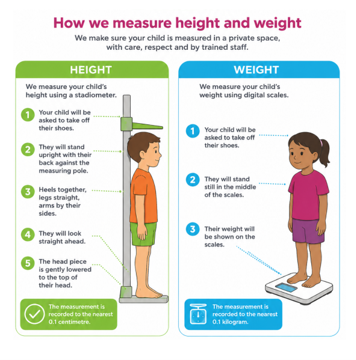
The National Child Measurement Programme (NCMP) is a nationwide programme in England where children in Reception (aged 4–5 years) and Year 6 (aged 10–11 years) have their height and weight measured at school.

Measurements are carried out by registered school nurses or trained child health professionals in a private area away from other pupils. Children remain fully clothed, removing only their coat and shoes.

The information collected helps to:

  • Monitor children’s growth nationally and locally.
  • Understand trends in childhood growth and healthy weight.
  • Plan and improve local health and wellbeing services.
  • Inform public health programmes that support children and families.

What to expect

Before the Measurement

You will receive an information letter explaining the programme.

You can choose for your child not to take part by following the instructions provided in the letter

Measurements take place during the school day in a private area within the school.

Trained healthcare staff carry out the measurements.

Your child will be measured one at a time to protect their privacy.

Staff will measure: Height (without shoes) and Weight (without shoes and wearing normal school clothing)

The measurements usually take less than five minutes.

Children are never weighed in front of their classmates.

Results are treated confidentially.

Staff aim to make the experience quick, respectful and reassuring

Staff do not discuss a child’s weight or BMI with them during the measurement.

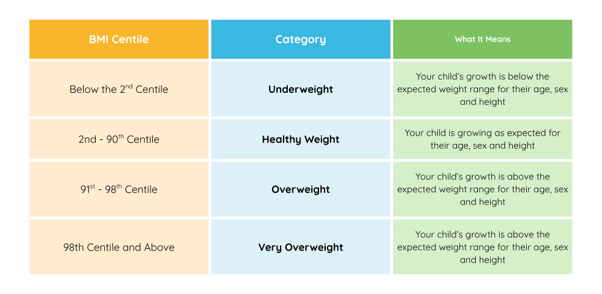
After your child has been measured, they will receive a recording that classifies their BMI as either underweight, healthy weight, overweight or very overweight. Further information on what this means can be shown below. 
 
If your child is a ‘Healthy Weight’ and growing as expected, you ordinarily would not receive a letter, but if you would like to receive your child’s measurements please contact us via our Single Point of Contact.
 
If your child’s result is classified as ‘underweight’, ‘overweight’, or ‘very overweight’, the support available may vary depending on local services. You may be contacted by letter or telephone to discuss the result and any support that may be available through the 0-19 Service. 
 
If you would like to discuss your child’s result further or confirm the information provided, please contact our Single Point of Access. We welcome enquiries and are happy to discuss any questions or concerns you may have.

Video

For more information, you can watch this NCMP process animation. The animation explains the process of the NCMP and why it is important. It will guide you through what it involves, how your child’s data is collected and processed and what it will be used for.

Results

Plotting BMI Centiles

  • The height and weight measurements taken during screening are used to calculate the child’s Body Mass Index (BMI).
  • Body Mass Index is calculated by dividing the weight in kilograms by their height in metres squared   
  • Once the BMI is calculated, it is plotted onto the appropriate centile chart
  • This is done so by finding the child’s exact age along the bottom of the chart and finding the calculated BMI on the left-hand

A point is marked where the child’s age and BMI meet.

We can then see which centile line the dot sits on or between.

Centile Categories 

Vision Screening

The NHS recommends that all children have a vision screening test at 4 to 5 years of age. This test checks for reduced vision in one or both eyes. Children often do not realise they have a vision problem and may not complain, especially if only one eye is affected. Finding vision problems early means your child can get effective treatment as soon as possible.

What to expect

Before the screening

You will receive an information letter explaining the vision screening programme.


You can choose for your child not to take part by following the instructions provided in the letter

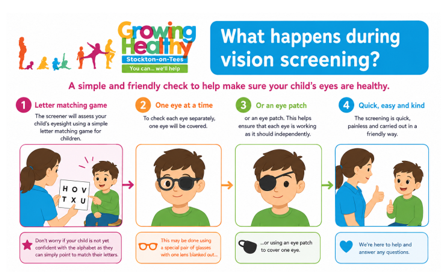
The vision screening test is quick, painless and non-invasive, usually taking just a few minutes to complete. It is designed to be a fun and child-friendly experience.


During the screening, the screener will assess your child’s eyesight using a simple letter matching game for children. Don’t worry if your child is not yet confident with the alphabet as they can simply point to match their letters. To check each eye separately, one eye will be covered using either a special pair of glasses with one lens blanked out or an eye patch. This helps ensure that each eye is working as it should independently.

Following your child’s vision screening, if your child requires a further vision assessment, they will be referred to the local Community Children’s Optometry service for more detailed testing. This service is completely FREE and is delivered by local trained ophthalmology professionals. Dependent upon the result your child may be referred to visit a local Optician, or referred to a Consultant Ophthalmologist. This would be communicated with you via letter so please look out for this letter arriving. 
 
If your child’s measurements are within normal range then no further action is required and we would ordinarily not send you a letter regarding this but you can contact your local 0-19 team should you wish to follow this up.
 

Children can access free NHS eye tests while they are in education. All children under 16, and young people aged 16–18 in full-time education, are entitled to free NHS sight tests. If glasses are needed, they may also be eligible for an NHS voucher to help with the cost. If you have any concerns about your child’s vision, you can book an appointment directly with an optician

Audiology

In the UK, hearing screening is offered to children in Reception (typically aged 4–5 years) to identify potential hearing problems at an early stage. The screening is usually carried in school and involves trained professionals conducting a simple listening game using headphones.

What to expect

Before the Measurement

You will receive an information letter explaining the audiology screening programme.

Audiology tests are a consent based service, therefore we need parent/carers to return the information sheet to ensure that we can complete this test safely for your child. If you have not received this letter or wish to get in touch to discuss please contact your local 0-19 team

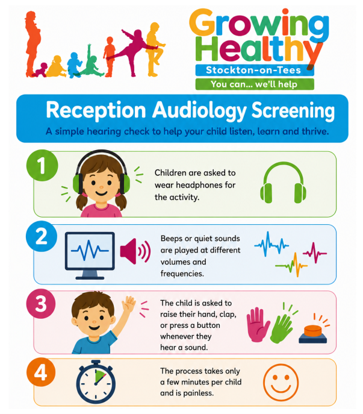
The hearing screening test is quick, painless and non-invasive, usually taking just a few minutes to complete. It is designed to be a fun and child-friendly experience.

During the screening, your child will be asked to wear a pair of headphones and listen carefully for a series of quiet beeps played at different volumes and pitches. Each time they hear a sound, they will be asked to respond by raising their hand, clapping or pressing a button. This simple hearing check helps identify children who may benefit from further assessment and support if needed.

Children are never weighed in front of their classmates.

Results are treated confidentially.

Staff aim to make the experience quick, respectful and reassuring

Staff do not discuss a child’s weight or BMI with them during the measurement.

Following your child’s hearing screening, if their hearing is found to be within the expected range, no further action will be required. If a child’s test shows reduced hearing levels then a repeat screening will usually be arranged at school. Reduced hearing can sometimes happen due to a minor cold, fluid in the ear, tiredness or lack of concentration on the day rather than permanent loss of hearing.  If the second screening also indicates that further assessment is needed, your child will be referred on for further support. You will be contacted with information about the next steps.

Local Screening Offers

Local Area

National Child Measurement Programe (NCMP)

Vision

Audiology

Opt Out Contact Information

Cumberland

National Child Measurement Programe (NCMP)

Vision

Audiology

Opt Out Contact Information

hdft.spoc0-19cumberland@nhs.net

Darlington

National Child Measurement Programe (NCMP)

Vision

Audiology

Opt Out Contact Information

hdft.0-19darlington@nhs.net

Durham

National Child Measurement Programe (NCMP)

Vision

Audiology

Opt Out Contact Information

hdft.schoolscreeners@nhs.net

Gateshead

National Child Measurement Programe (NCMP)

Vision

Audiology

Opt Out Contact Information

spoc.hdftgateshead@nhs.net

Middlesbrough

National Child Measurement Programe (NCMP)

Vision

Audiology

Opt Out Contact Information

hdft.mborohealthychildservice@nhs.net

Northumberland

National Child Measurement Programe (NCMP)

Vision

Audiology

Opt Out Contact Information

hdft.spocnorthumberland@nhs.net

North Yorkshire

National Child Measurement Programe (NCMP)

Vision

Audiology

Opt Out Contact Information

hdft.0-19nyorks@nhs.net

South Tyneside

National Child Measurement Programe (NCMP)

Vision

Audiology

Opt Out Contact Information

hdft.spocsouthtyneside@nhs.net

Stockton

National Child Measurement Programe (NCMP)

Vision

Audiology

Opt Out Contact Information

hdft.stockton0-19service@nhs.net

Sunderland

National Child Measurement Programe (NCMP)

Vision

Audiology

Opt Out Contact Information

spoc.hdftsunderland@nhs.net

Wakefield

National Child Measurement Programe (NCMP)

Vision

Audiology

Opt Out Contact Information

hdft.wakefield0-19admin@nhs.net

Westmorland & Furness

National Child Measurement Programe (NCMP)

Vision

Audiology

Opt Out Contact Information

hdft.spoc0-19waf@nhs.net

Recite toolbar icon
x

What would you like to search for?