


Healthy Lifestyles


The information on this page aims to support you and your family to eat better and move more. If you want support or advice about growth and healthy lifestyles, you can call your local health team. Find the number by clicking your local area under 'Our Services' in the menu above.
Supporting your child to be physically active
How we use and move our bodies is essential in living a healthier and more balanced lifestyle. Exercise for children is very important for their natural development. Being involved in exercise can help to develop general fitness, balance and coordination, help build muscles and bones, improve sleep quality and boost our immune systems to fight of infections. Exercise also produces endorphins and serotonin which is just one of many ways that regular physical activity can help us fight off negative mental health problems. Physical activity also provides an opportunity for us to socialise, make new friends and develop new interests.
⏱️How much exercise should by child be doing?
- Under 5s should aim for at least 180 minutes per day.
- Children aged 5-18 should aim for at least 60 minutes per day (moderate/vigorous intensity).
- Adults should aim for at least 150 minutes of moderate intensity or 75 minutes of vigorous intensity per week.
- Children and young people should aim to do both aerobic exercises and exercises to strengthen their muscles and bones.
- They should aim to take part in a variety of types and intensities of physical activity across the week to develop movement skills, muscles and bones.
Balancing Energy
Energy balance refers to the relationship between the energy (calories) we take in through food and drinks and the energy that the body uses for growth, daily activities, bodily functions plus any additional through physical activity.
Maintaining a healthy energy balance is essential for healthy growth, development, and long-term health. Having too much or too little energy in the body over time can impact our growth and our health. Energy balance is achieved through everyday choices in both what you eat and how active you are.
For more information on supporting your child’s physical activity, please click the links and resources below.
Supporting your child to eat healthily
Having a healthier weight can improve your child’s health and wellbeing. If you are not already doing so, eating healthily can be good for the whole family. This can be hard for a lot of people, so there is help available.
Understanding Food Labelling
Food labels tell us what is in the foods and drinks we buy. It’s important to know where to find the information you need and what it means. Understanding and using these labels in your day to day life when shopping can help you make healthier lifestyle choices.
To learn more about Food Labelling and for information of other ways to encourage your child to eat a healthy, balanced diet, please see our links & resources below.
Supporting your child to have healthy gums and teeth
Healthy gums and teeth are also part of a healthy lifestyle. Simple advice available at the NHS ‘Children’s teeth’ webpage will help your child have healthy gums and prevent tooth decay.
For further information on looking after your child’s teeth visit the webpages below
Healthier Eating
To eat healthier, it is important to understand that lifestyle should be about enjoying balance and moderation. Although we should eat plenty or fruits and vegetables, eat protein from lean sources and maintain sufficient carbohydrate intake, we must also enjoy our food and once in a while indulge a little in the things we love.
5-a-Day
The World Health Organization and the Department of Health recommend that you should aim to eat at least five portions of a wide variety of fruit and vegetables a day. Evidence shows there are significant health benefits to getting at least 5 portions of a variety of fruit and vegetables every day. That’s 5 portions of fruit and veg in total, not 5 portions of each.
Eating a variety of different fruits and vegetables is important to make sure you get a range of vitamins, minerals and nutrients.
Foods High in Fats & Sugars
Foods high in fats and sugars can contribute to a range of health problems when eaten too often. Too much sugar can lead to tooth decay, weight gain and a higher risk of type 2 diabetes, heart disease and some cancers, while too much saturated fat can cause harmful fat build‑up in the blood. Making small everyday swaps—such as choosing lower‑sugar drinks or lower‑fat alternatives—can help improve overall health.
Fats
Fat is an important part of a balanced diet, providing energy, essential fatty acids and helping the body absorb vitamins and minerals. However, saturated fats should be limited because they are linked to increased risks of heart disease, stroke, type 2 diabetes and some cancers. Unsaturated fats, on the other hand, are considered healthier and support energy levels while reducing fatty build‑up in the blood. Reducing fat intake can be achieved through simple changes such as grilling instead of frying, choosing lean proteins, trimming visible fat from meat and swapping to lower‑fat versions of common foods.
Sugars
There are naturally occurring sugars found in foods like milk, fruit and vegetables, but the sugars of most concern are free sugars, which are added to foods such as fizzy drinks, sweets, cereals, cakes, biscuits, honey and syrups. Most adults and children in the UK consume too much free sugar, increasing the risk of tooth decay, weight gain and obesity‑related conditions. Government guidance recommends keeping free sugars to no more than 5% of daily energy intake. Small swaps—like choosing diet drinks, lower‑sugar cereals, “no added sugar” sauces and fruit instead of syrups—can make a significant difference.
Eatwell Guide
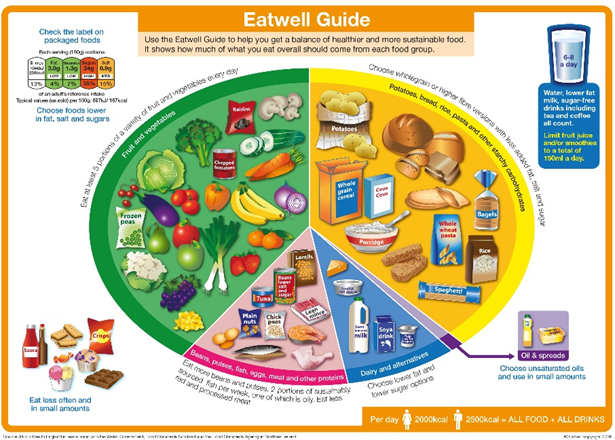
The Eatwell Guide is a visual aid that shows what a healthy and balanced diet should consist of. It divides foods into key groups such as: fruits and vegetables, starchy carbohydrates, proteins, dairy or alternatives and oils and spreads and shows how often foods should be eaten from each group. In addition to the previously discussed food groups, the Eatwell Guide also provides important information on hydration and foods that fit into the category of high fat, sugar and/or salt.
The guide is important because it helps people make choices about what to eat and how often to eat certain foods. In the long term this can support good health, reduce the risk of disease and keep our bodies strong and full of energy.
Portion Control
A healthy, balanced diet means not only eating the right types of food and drink, but also eating them in the right amounts.
Portion control helps us to understand the amount of food you should eat depending on how much energy your body can use. It is important that we consume the right amount of energy for our body’s demands as too much or too little can have negative impacts on our health.
The amount of energy we need to consume, varies from person to person. Factors such as age, gender, height and weight can affect how much food we need! At different ages, children will require different amounts of food to meet their changing energy needs.
Portion control is important for children and young people as it can help to prevent overeating, and teaches children to listen to their hunger cues. It’s not about restricting food — it’s about balance and awareness.
Handy Portion Guide
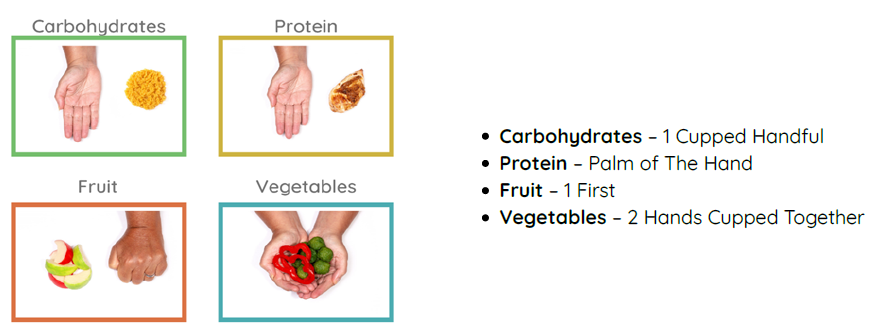
- One easy way to better understand what a person’s portion sizes should be is to use their hand as a guide.
- Everyone has different sized hands, which serves as a reminder that everyone requires different portions.
- Hands are portable. They come with you everywhere so can always help to guide you in making smart portion choices
- Hands scale with the individual which meals that we are managing our portions over time
- Using hand-size portions can help you track your portions easily and saves time by avoiding unnecessary weighing and measuring of food, which most people don’t need to do.
- When doing this activity with the child or young person, consider the different sized hands that may be in their household – parents/guardians and siblings. It’s a good reminder for children that it is ok if they are eating less than their older siblings and that parents are not being unfair by offering different amounts but instead are simply meeting the energy needs of each child/person in the household.
Move More
Physical Activity
How we use and move our bodies is also essential in living a healthier and more balanced lifestyle. Exercise for children is very important for their natural development. Being involved in exercise can help to develop general fitness, balance and coordination, help build muscles and bones, improve sleep quality and boost our immune systems to fight of infections. Exercise also produces endorphins and serotonin which is just one of many ways that regular physical activity can help us eight off negative mental health problems.
For children aged 18 and under it is advised that they should engage in at least 60 minutes of exercise per day. It is also advised that children take part in vigorous activity 3 times a week to help develop muscle and bone.
Physical activity is not only beneficial for our physical and mental health, but it also provides an opportunity for us to socialise, make new friends and develop new interests. It is important to find physical activity that is fun and enjoyable!
N.E.A.T
Non-Exercise Activity Time or N.E.A.T is a fancy name to describe the energy that you burn from your daily activity. This is basically any movement that you do that is not from exercise. It can make a big difference in helping you to get active and increase your movement throughout the day. Focusing on N.E.A.T can help you to become more physically activity during your normal daily routine.
Some examples of N.E.A.T can include: tidying up, washing the pots, hoovering, gardening and helping out with shopping.
Smoking
When you quit smoking, good things start to happen — you can begin to see almost immediate improvements to your health.
It’s much easier to quit when you get the right support and there are lots of options to choose from. Check out our free tools and tips to help you stay on track.
For more information
Healthy Recipe Videos
Resources